
Supporter Insights & Understanding: We know what they did. Do we know why?
Updated: 3 days ago
Understanding supporter motivations, asking better questions and finding out why people leave.

Someone has been giving to your organization for eight years. They open some emails, ignore others, occasionally sign a petition, never reply to direct mail, and have never increased their monthly gift.
What do you know about them?
You know a lot about what they’ve done, when they’ve done it, and how much they’ve given. You might know which campaign brought them in. But do you know why they’re still here? What they think their contribution is doing? Whether they feel connected to the organization, or just haven’t got around to cancelling?
This is a deeper kind of knowing. It’s the knowing that allows you to do something to make improvements once you know.
Supporter Insights & Understanding is the dimension of Supporter Experience concerned with understanding people’s motivations, expectations, feelings and behaviours, then using that understanding to make better decisions.
Not just collecting information. Understanding something usable.
Why do donors stop giving—or volunteers stop coming back?
These are reasonable questions, particularly when you’ve put a lot of work into getting people involved in the first place. But a list of people who have left won’t, on its own, tell you why they left.
We need to hear from them. What changed? Was something missing from the experience? Did they want a different way to participate, or did something happen in their lives that had nothing to do with us but created a circumstantial change for them?
The same applies to the people who stay. It’s tempting to assume that continued giving means someone is happy with the relationship. It might. It might also mean they care deeply about the cause despite an experience that isn’t doing much to strengthen that connection.
This is where supporter research earns its place. Not because a survey and series of conversations will neatly explain every decision, but because it gives us something better to work with than the explanation we’ve come up with ourselves. It takes us from assumptions to insight.
There’s a person behind the segment
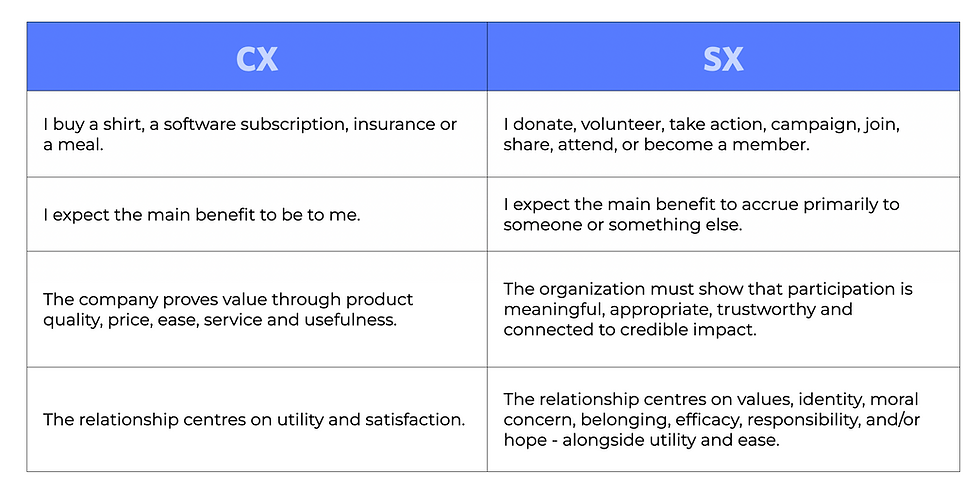
In CX (Customer Experience), understanding what someone is trying to accomplish is an important starting point - usually that is to use, wear, eat, consume whatever the product is. In SX (Supporter Experience), that purpose is very likely to be less tangible and more personal.
Someone might be honouring a family member, expressing their values, responding to something that makes them angry, or finding a way to contribute when the problem feels overwhelming. The transaction doesn’t tell us all of that.
And their giving history isn’t their whole relationship with us. They might also volunteer, advocate, attend events or talk about our work in their community. If we only research donors, and only ask questions about donating, we’ve already put a fairly significant boundary around what we’re going to learn.
What listening can look like
The British Red Cross heard from around a thousand supporters through its May 2026 survey. Among the findings, awareness of its international humanitarian work was stronger than awareness of some of its other activities. It shared the findings publicly and explained how they would inform its communications, including showing more of the breadth of its work and explaining how donations are spent.
They are not simply conducting a survey - they’ve shown the connection between listening and what happens next. It’s turning the listening into an active supporter experience change that shows that you’re not just listening for listening’s sake.
We need to get good at collecting and interpreting the feedback from listening posts, and then we need to get equally good at using it.
How this connects to the other dimensions
Insights should shape the strategy: what experience are we trying to create, for whom, and why? They should guide what we design or improve. Measurement helps us understand whether the change worked, while culture and accountability make it normal to ask, “Do we actually know this, or do we think we know it?”
You don’t need a huge research program to begin.
Take one decision you’re working on and write down the assumptions you’re making about supporters. Then ask which assumption you’d be least comfortable being wrong about.
That’s a good place to start listening.
Explore the other four dimensions
Supporter Experience Strategy: What are we actually trying to create?
Experience Design, Improvement & Innovation: What happens after we understand?
Metrics, Measurement & ROI: Did we raise more money, or build a better relationship?
Culture & Accountability: Everyone’s job, but whose responsibility?


Comments