
Experience Design, Improvement & Innovation: What happens after we understand?
Updated: 3 days ago
Using supporter journey mapping to improve what happens before, during and after someone takes action.

Imagine someone signs up to volunteer.
The form works. They get a confirmation. Their details go into the right system. From the organization’s perspective, this might look like a successful interaction.
Except the person doesn’t know when they’ll hear from you, whether they need to do anything else, if they’re in a pool to be selected from, how likely they will be to get a volunteer position or if they should keep Saturday free.
Nothing is technically broken. The experience still isn’t very good.
Experience Design, Improvement & Innovation is the work of deliberately shaping what happens, using what we understand about people rather than assuming that a functioning process will produce a good experience.
Design considers how the experience should work. Improvement addresses what isn’t working well enough. Innovation gives us room to explore a different way of meeting the need altogether.
What happens after the first gift?
Someone gives for the first time. They receive a receipt, perhaps a thank you, and then… what?
What do they understand about the organization now that they didn’t before? Do they know what to expect? Does the next communication recognize that they’ve just joined, or have they arrived halfway through whatever everyone else is receiving?
A nonprofit welcome series can help, but the series isn’t the whole experience. Neither is a donor welcome packet. We need to look at what happens around those communications too, including what happens if the person replies, asks a question or wants to participate in another way.
The same applies to volunteers, members and advocates. There’s the action we’ve asked them to take, and then there’s everything that makes that action feel worthwhile, confusing, welcoming or strangely unfinished.
Looking at the supporter journey
Supporter journey mapping helps us examine the experience across the steps, not just whether we delivered each individual piece. Donor journey mapping is one application of it, focused on the giving relationship.
What is the person trying to do? What are they expecting? Where are they waiting, repeating themselves or wondering whether anyone noticed?
Then we need to look behind the scenes - both with the representatives of our organization, and the systems behind them. What information, process or handover would have to change for their experience to be different?
This is why experience design can’t just sit with whoever writes the emails. The email may be where the problem becomes visible, not where it begins.
An example from NSPCC
NSPCC worked with data and technology partner Euler to connect supporter information and develop more timely, relevant communications across fundraising and volunteering. Euler brought information together from multiple sources and using actions, preferences and engagement history to inform supporter journeys. For Childhood Day, it reports a 12.5% year-on-year increase in returning volunteers.
What’s interesting to consider is the connection between the visible experience and the less visible work required to deliver it. Relevant communication depends on someone knowing what happened before, having access to that information and being able to act on it.
Better doesn’t always mean more efficient
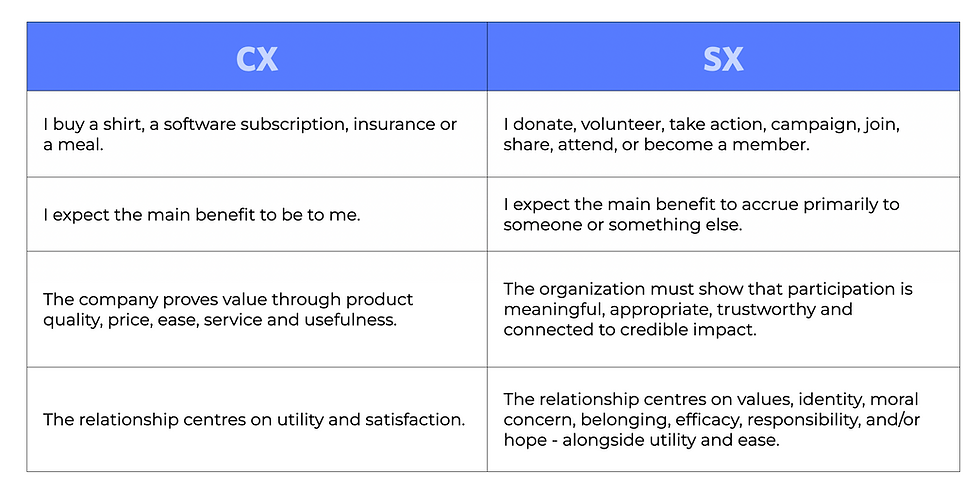
We should make it easier for people to participate. But in SX, completing the action isn’t the whole experience.
Someone can donate in thirty seconds and still have no idea what their contribution means. Removing friction matters; helping people understand their part matters too.
Insights help us identify the need. Strategy gives us a direction. Measurement tells us whether a change helped. Culture and accountability determine whether the right people can work together to deliver it.
Choose one journey and follow it properly, including the waiting and the handovers. Make one improvement and test it with the people affected.
You don’t need to redesign everything to make something noticeably better.
Explore the other four dimensions
Supporter Insights & Understanding: We know what they did. Do we know why?
Supporter Experience Strategy: What are we actually trying to create?
Metrics, Measurement & ROI: Did we raise more money, or build a better relationship?
Culture & Accountability: Everyone’s job, but whose responsibility?


Comments