
Supporter Experience Strategy: What are we actually trying to create?
Updated: 3 days ago
A supporter experience strategy keeps people connected—not just on the list.

Most non-profits have a pretty good idea of what they want supporters to do.
Donate. Renew. Register. Sign. Share. Show up.
We’re generally less clear about what we want people to experience while they’re doing those things, and between those things, and during the periods when they’re not doing very much at all.
That’s the work of Supporter Experience Strategy.
What is a supporter experience strategy?
A supporter experience strategy sets a shared direction for the relationship your organization wants to build with supporters, and the choices you’ll make to deliver it.
It connects what you understand about people with your mission, your values, your priorities and the experience you can realistically provide.
It isn’t the same as a communications calendar, although it should influence one. It isn’t a collection of journeys, although it should guide those too. And it isn’t simply deciding that everyone should feel “valued,” because most organizations would agree with that and still make quite different decisions day to day about what happens with and to supporters.
The supporter experience strategy needs to help with all of that, and dovetail with the organization’s strategy.
Say someone volunteers regularly, gives occasionally and has asked for fewer emails. Three teams have something they would very much like to send them this week.
What happens?
Each team could make a perfectly reasonable decision from its own perspective, while the supporter gets the combined result. A shared strategy gives you somewhere to take that decision beyond what team’s deadline is closest.
How do we keep donors and volunteers engaged?
This question can quickly become a conversation about what else to send people. Another update, a new newsletter, a different invitation. And perhaps one, or some, of those things is needed.
But what happens if we back up a little. What do we mean by engaged? Giving regularly? Taking action? Feeling connected to the work, even if they haven’t clicked on anything recently?
Keeping volunteers engaged isn’t necessarily about giving them more to do. We need to understand what makes their involvement worthwhile to them, then decide how we’re going to support that relationship.
That’s a strategy question before it’s a content question.
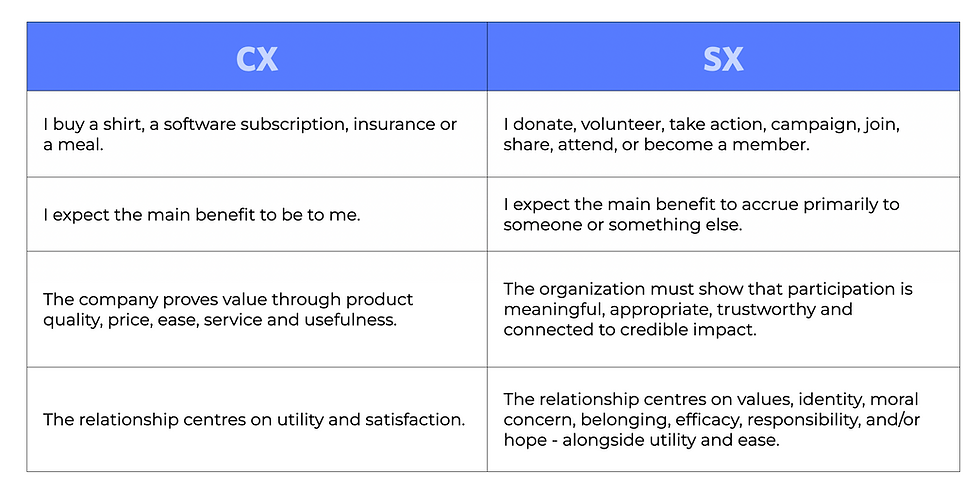
It also brings us to an important SX distinction: the relationship is with the mission, not our departments. Our supporters haven’t separated fundraising from advocacy from volunteering in the way we have - and if you’re doing SX right, they never will.
A useful strategy makes room for all different forms of participation, and doesn’t just treat them as steps towards a larger donation.
A shared direction in practice
The phrase ‘North Star’ is used both in organizational strategy and in SX strategy. It is important to define a shared direction based on the organization's values and supported by principles that clarify what meaningful supporter experience should look like.
A North Star is helpful if people can actually use it to navigate. The test on if your North Star is working is whether it helps you make a choice, particularly when the choice involves giving something up.
Where the other dimensions come in
Without insight, we’re building a strategy around our own idea of what supporters want. Without design and improvement, we have a direction but nothing changes. Without measurement, we don’t know whether we’re getting anywhere. Without culture and accountability, following the strategy becomes optional when things get busy (which is always).
Start with a few experience principles grounded in what you’ve learned from supporters. Something like “we recognize the different ways people contribute” or “we make it clear what happens after someone takes action.”
Then bring an actual, slightly awkward decision to the table.
Do the principles help? Do they change what you would do?
If not, keep working on them and tighten them until they do.
Explore the other four dimensions
Supporter Insights & Understanding: We know what they did. Do we know why?
Experience Design, Improvement & Innovation: What happens after we understand?
Metrics, Measurement & ROI: Did we raise more money, or build a better relationship?
Culture & Accountability: Everyone’s job, but whose responsibility?


Comments