
Supporter Experience: Not just CX for charities
Supporter Experience is often described as ‘customer experience for charities’. It’s not wrong but misses some fundamental differences.
I write this for two reasons:
The first is that non-profit leaders often fall into two camps around this. Camp 1: We should learn from the for profit world and do what they’re doing. Camp 2: Non-profits are fundamentally different than for profit companies and we don’t need to take their advice on how we do things.
The second reason is that the Experience discipline is led by Customer Experience. Supporter Experience is still fairly young and unknown. Supporter Experience also does not have a standard discipline of study in the same way that Customer Experience does, SX professionals are still figuring it out. A person can become a globally Certified Customer Experience Professional (CCXP), and for many of us working with non-profits, this is the certification we complete knowing there are adjustments to be made when thinking about Supporter Experience.
Supporter Experience evolved from the success (and logic) of the Customer Experience discipline which focuses on understanding a customer’s experience (including perceptions, emotions, expectations and interactions) with a brand over time. Essentially it boils down to: if you provide a better customer experience, more people will like you and return as customers, and more people will recommend you to others.
Both CX and SX are focused on understanding people’s experience, both use quant and qual research, journey mapping, service design, measurement, segmentation, communications and cross-functional change. Both improve when organizations understand people’s needs instead of organizing around internal processes.
BUT - applying CX tools in a non-profit is not the same as applying them in a business.
The exchange itself, the identities involved, the definition of value and the desired outcome are all different.
Big difference #1: The benefit goes somewhere else
Here is a super simple framing of CX versus SX.
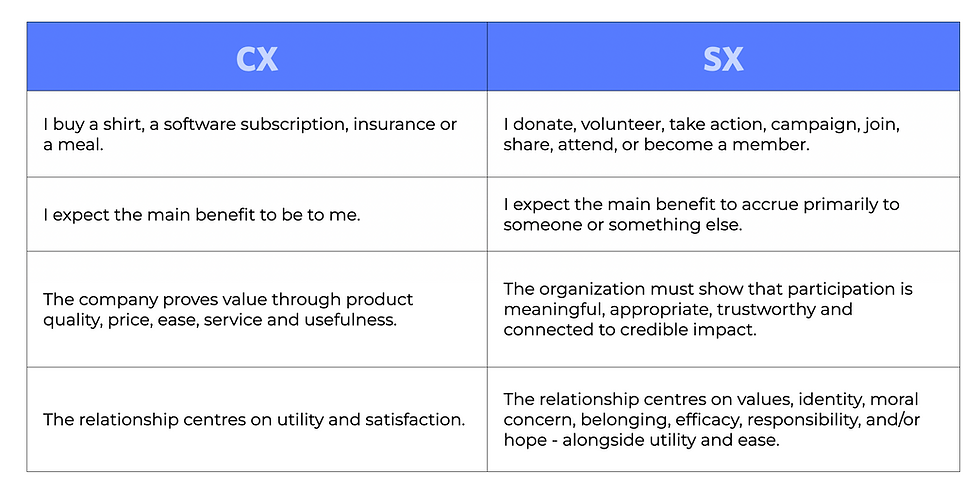
Even the sheer number of words that are on the right of the table versus the left is a key indicator of the biggest difference between them. There is so much more complexity to Supporter Experience. CX is already complex. SX is more complex because of the simple fact that when supporters give (and there’s so much to give) to a non-profit there are a host of reasons that don’t amount to “I get a tangible benefit because I paid for it.”
Now this isn’t to say that customers are inherently selfish, or that supporters expect nothing in return (and let us always remember that all non-profit supporters are also customers of for profit companies). In fact, supporters can also be beneficiaries, for example donating to the school so that your kids can get to the track meet via bus (got this request today because of provincial funding cuts to schools :( ).
The practical consequence of this difference is that supporter experience needs to keep confidence through an indirect and delayed feedback loop. In fact, the feedback may never directly come. A climate advocate cannot personally experience the avoided harm. A supporter who shares a campaign may not know whether one post shifted a decision-maker or added one more signal to a growing public conversation.
Many non-profits are constantly trying to figure out ‘tangible benefits’ in a space that is often in no way tangible.
Big difference #2: ‘Customer’ is simple; ‘supporter’ is plural
Ok, it’s true, ‘customer’ is not totally simple in the real world - users, buyers, decision-makers, account holders, etc. But in most commercial contexts ‘customer’ still identifies a person in a recognizable economic relationship with a business - they are buying, using, renewing, evaluating or leaving a product or service.
‘Supporter’ on the other hand, names a relationship to a mission.
Someone could be a supporter by:
giving money
giving money repeatedly
volunteering time or skills
being a member and receiving benefits
being a political or public advocate
fundraising and recruiting others to the mission
participating in an event and giving attention, energy, participation fees and social reach.
being a service user while also being a donor, advocate, volunteer or community leader
being a social follower who amplifies messages
receiving information and changing their own habits as a result (eg MADD is credited with making impaired driving socially unacceptable and building pressure for policy change)
There are likely many more I haven’t listed. The role of ‘supporter’ is multi-faceted and dynamic. People can flow from one to another and back again depending on their interest, their time, their disposable income, their energy, their influence. The journey is not linear, and roles overlap.
This has major implications in the world of Supporter Experience. A single ‘donor journey’ can be misleading if it assumes every relationship is donor first. A person’s current behaviour doesn’t tell you their full relationship or future potential. Channel ownership becomes tricky - advocacy, fundraising, digital, events, membership, gift-shop, volunteering or programs likely own parts of the same person’s experience.
We can often fall into the trap of thinking that supporters are people at the early stage of the funnel, before they take an action and become a volunteer, advocate or donor, but supporters are supporters throughout the entire journey. Supporters are not simply an unconverted prospect waiting to become a donor. These other active names can be thought of a tags or supplements to the supporter themself.
Same Principles, Nuanced Practice
We started with Camp 1 (We should learn from the for profit world and do what they’re doing) and Camp 2 (Non-profits are fundamentally different than for profit companies and we don’t need to take their advice on how we do things.) both camps are right with an adjustment - borrow CX’s discipline but not its assumptions.
Fundamentally it makes sense to borrow the principles of CX - understanding who people are and what moves them to action is critical to an organization’s success. CX offers vital ways to serve customers better. SX just needs a more nuanced way of applying the principles, and a very considered approach to strategy and measurement. We need to use the same toolkit: understand feelings and behaviours, figure out what’s hard, improve it, measure it - but SX also needs to understand why someone wants the world to be different and what part they want to play.
A few practical adjustments for SX:
Treat supporters as participants on the organization’s mission (not just a source of revenue)
Design for multiple forms of contribution, not only the next donation
View awareness, trust, learning and collective action as mission-relevant outcomes
Give people a view into how their action fits into the work
Great supporter experience helps people see, feel and create value beyond themselves.


Comments