
Donor Retention Isn’t Just Fundraising’s Job
When we talk about ‘Supporter Experience’ very often our brains hear “donor experience”.
When we ask how to improve donor retention or how to keep supporters engaged, we start with fundraising – the appeal, the thank you, the next ask. Those things matter but they are only part of the relationship a supporter has with your organization. Better supporter experience starts when marketing and fundraising look beyond the interactions their own teams manage.
The reality is that donor experience is just one part of supporter experience. A better fundraising email cannot, on its own, fix an experience that feels disconnected, full of friction or simply doesn’t recognize the supporter as one individual person.
Supporters don’t think of themselves in the internal silos we create behind our doors – they just want to support an organization they value and trust. We need to come up a level, from donor or volunteer or advocate or member to supporter. We need to look at the experience as a system and understand what it feels like from the supporter’s perspective.
So, what is Supporter Experience (SX)?
Supporter Experience (SX) is the sum of everything people think, feel and do through every interaction they have with an organization over time. It includes their experiences as donors, members, volunteers or advocates (or insert internally defined group here), and the ways those roles overlap.
Understanding that experience helps us identify what encourages people to stay involved, what puts them off and what needs to change.
SX is a discipline, with a field of study, practice groups, and conferences, but it is also a recent development especially in the North American market where much talk of SX still centres on donor experience.

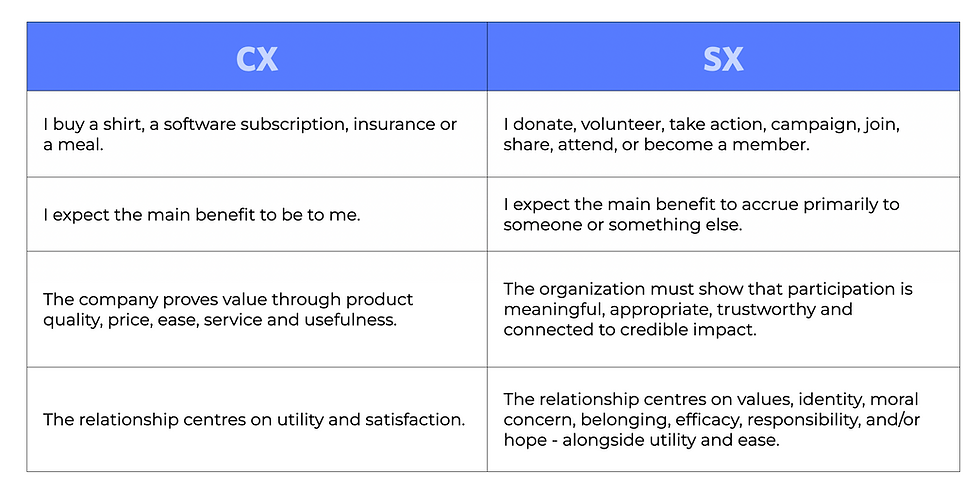
SX borrows from Customer Experience (CX) – an older discipline, with more research, rigour, structure, a professional association and everything that comes with that. With SX, supporters are participating in a mission, not buying something. Their contribution might be money, time, influence, attention or a combination of those that changes throughout their lives.
A lapsed donor might still be volunteering. A petition signer might also be a member. A first-time donor might have been a social follower for a decade. These aren’t separate audiences; they can be different parts of one person’s relationship with the organization.
SX is much messier and more complicated than CX because of this. This means we need to lean in and understand the complexity of how people experience our organizations so that we can take that understanding and improve the supporter’s experience – this is what will drive the biggest improvement in lifetime value.
Different teams, one relationship
A supporter signs a petition, attends an event and then makes a donation.
Marketing sees campaign engagement.
Events sees an attendee.
Fundraising sees a new donor.
Each team might prepare a perfectly reasonable follow-up. But does it make sense when those messages arrive together? Do they recognize what this person already knows and has contributed? Or does each interaction start the relationship again and suppress the last relationship?
The question we often ask ourselves is “How do we follow up with donors without overwhelming them?”. But I think we’re asking the wrong question. We should be asking ourselves is “What would make this person feel understood, connected and interested in staying involved?”
In conversations with monthly supporters of a national environmental organization, some told us they felt unrecognized. Advocacy emails were part of that experience. They heard regularly from another team, but those communications didn’t acknowledge their ongoing support. The issue wasn’t that donors needed different advocacy content, it was that the teams needed to consider how their communications added up for the same person. A simple adjustment of adding a bi-annual thank you to monthly supporters both showed existing donors their contributions were important and valued, and showed non-donors that monthly gifts were something to consider.
Before they became a donor
This kind of recognition and understanding matters even more when someone’s relationship begins as a service user.
Consider a hospital patient or family member who later chooses to donate, fundraise or volunteer. Their relationship didn’t begin with the foundation’s welcome email. It began with receiving care, likely in a scary or emotional circumstance. Their reasons for getting involved might be gratitude, a desire to help others’ families, or a wish to change something they found difficult. Becoming a donor doesn’t erase that experience, it builds on it.
Recognizing the wider relationship does not mean giving fundraisers access to clinical records. It means understanding where some supporters might have an existing and deep relationship with your organization and treating them as such.
In a children’s hospital project, we heard from parents whose children were now adults. Their connection to the hospital remained strong, even years after care ended. Stories about former patients at adults were particularly meaningful to them. Understanding that continuing connection gave us a more specific basis for recommending content than treating them simply as donors.
When SX has no owner
Supporter experience improvements can be fragile.
In a recent project, research shows that supporters who took part in a particular peer to peer fundraising product were more likely to go on to donate (when fundraising becomes tedious or stale, they are still willing to give themselves). Improving the experience of that product was part of the agreed recommendations. But then the responsibility for that product was moved to another team. The team that had commissioned the work no longer saw it as theirs and the improvements stalled. The product moved teams, but the agreed improvements were not carried forward into the new team’s priorities.
Nobody did anything unreasonable. People focused on what they were accountable for. But the supporter experience didn’t improve because it didn’t sit with those who were thinking about supporter experience.
This is the big risk when supporter experience lives inside one department’s plan. A restructure, a new manager or a shift in targets can quietly leave a valuable part of the relationship with no one looking after it.
The sector says that Supporter Experience is everyone’s responsibility. That’s true. But when something is everyone’s responsibility it’s often nobody’s job.
Marketing might be measured on reach and engagement. Fundraising on income and repeat donations. Program or service teams have their own priorities. Each can make sensible decisions against its own goals while the overall relationship falls between them.
That is why SX can’t sit only with marketing or with fundraising. SX needs a senior sponsor with authority across the teams involved; someone who can resolve competing priorities, secure time and resources for agreed improvements and check that the work is delivered. Teams still own their activities, and the sponsor makes sure cross-team commitments do not disappear between them.
How to start
Build a shared picture – bring together what teams know from data, feedback and direct conversations. Look beyond the role assigned to someone in a database. Use supporter research and journey mapping to understand what happens between your organization’s planned interactions, not just during them. Understand from your supporters what their experience is.
Improve one experience together – take a specific moment that is creating unnecessary friction, discomfort or irritation for your supporters. Make a small change, ensure you plan how to measure success. Consider A/B testing.
Put ownership above any one team – name a senior sponsor for Supporter Experience. Build responsibilities into roles, not individuals, so commitments survive when people or structures change. Give each agreed improvement an owner, a deadline and a review date. When a product moves teams, transfer the supporter insights, agreed actions and measures with it.
Better Supporter Experience is about making supporter relationships feel connected, relevant and worthwhile.
Your teams may each be responsible for part of that experience. Who is responsible for the whole of it?
Article originally published on https://hilborn-charityenews.ca/donor-retention-isnt-just-a-fundraisings-job/


Comments